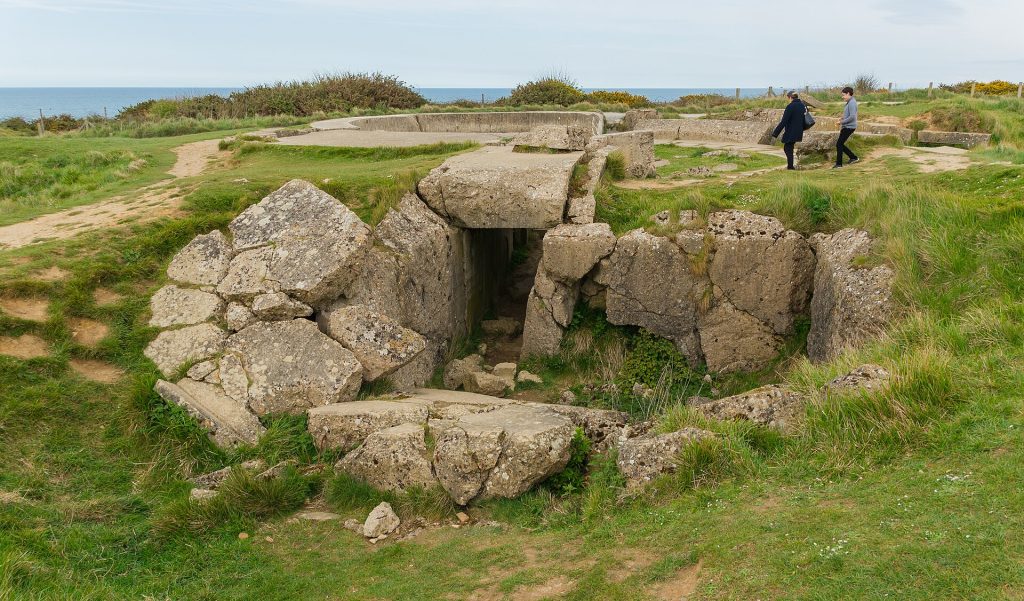
Pointe du Hoc is one of the most dramatic and haunting sites along the entire Normandy coast. A sheer promontory of jagged rock rising 30 metres above the Channel, it was targeted in the early hours of 6 June 1944 by the US 2nd Ranger Battalion — 225 men tasked with scaling the cliffs under fire to silence a battery of German guns believed to be capable of threatening both Utah and Omaha beaches.
At 06:30, Rangers used rocket-propelled grappling hooks, extension ladders and rope to climb the cliff face while German soldiers fired down upon them. Within minutes they had reached the top. The guns, however, were not in their casemates — they had been moved inland. Two Rangers, Sergeant Len Lomell and Staff Sergeant Jack Kuhn, found them in an orchard a kilometre away, primed and ready to fire on Utah Beach, and destroyed them with thermite grenades. Of the 225 Rangers who landed, only 90 were still able to fight two days later.
The Site Today
Pointe du Hoc has been preserved almost exactly as it was on 6 June 1944. The landscape is extraordinary: the entire headland is pockmarked with vast bomb craters, the result of Allied bombardment in the hours before the landing. Shattered German concrete bunkers and observation posts — some cracked open, some still intact, some tilting at vertiginous angles where the cliff has subsided — are accessible to walk through and around. It is one of the very few D-Day sites where you can step directly into the preserved battlefield.
The site has been maintained by the American Battle Monuments Commission since 1979 and is free to enter. A granite memorial at the centre of the headland marks the spot where American and French dignitaries have gathered for every major D-Day anniversary. The visitor centre provides context through maps, artefacts and first-hand accounts from the Rangers who climbed the cliff.
Practical Information
Pointe du Hoc sits between Utah Beach and Omaha Beach on the Calvados coast, making it a natural stop if you are visiting both. The site is open year-round and admission is free. Wear sturdy shoes — the terrain is uneven and the craters can be slippery after rain. Children should be supervised carefully near the cliff edges and open bunker interiors.
Getting There
Pointe du Hoc is approximately 1 hour from Château de Flottemanville by car, heading south-west via the D971 toward Grandcamp-Maisy. It is located between Utah and Omaha beaches and pairs naturally with visits to both, as well as the American Cemetery at Colleville-sur-Mer.